 IDS Auto
How weather conditions affect semi trailer transportation safety is not a minor scheduling concern. It is a direct operational risk. The Federal Highway Administration reports that adverse weather influences about 21% of vehicle crashes, 19% of injury crashes, and 16% of fatal crashes in the United States. These figures include rain, snow, fog, ice, and strong winds. Semi trailers face additional exposure because their high profiles catch crosswinds easily.
Paul Pisano, former team leader of the FHWA Road Weather Management Program, stated, “Weather is a factor in nearly 21 percent of all vehicle crashes.” His observation gives this topic practical weight. It connects weather data with decisions made inside a cab, dispatch office, and maintenance yard. The National Highway Traffic Safety Administration also identifies poor visibility and slippery roads as recurring contributors to serious collisions. (FHWA, Road Weather Management; NHTSA, Traffic Safety Facts.)
A wet highway can look harmless under headlights. It may still hide standing water, worn lane markings, or early hydroplaning. A gust can push an empty trailer across a lane. Snow can build around brakes, lights, and coupling equipment. Drivers need updated forecasts, realistic speeds, longer following distances, and careful tire inspections. Dispatchers should avoid treating a “clear” forecast as a guarantee. That assumption is often wrong. How weather conditions affect semi trailer transportation safety depends on timing, load weight, road design, equipment condition, and human judgment. The difficult truth is that even experienced teams can misread changing conditions. Safety improves when they question the forecast, monitor the road, and accept that delaying a trip may be the most professional decision.
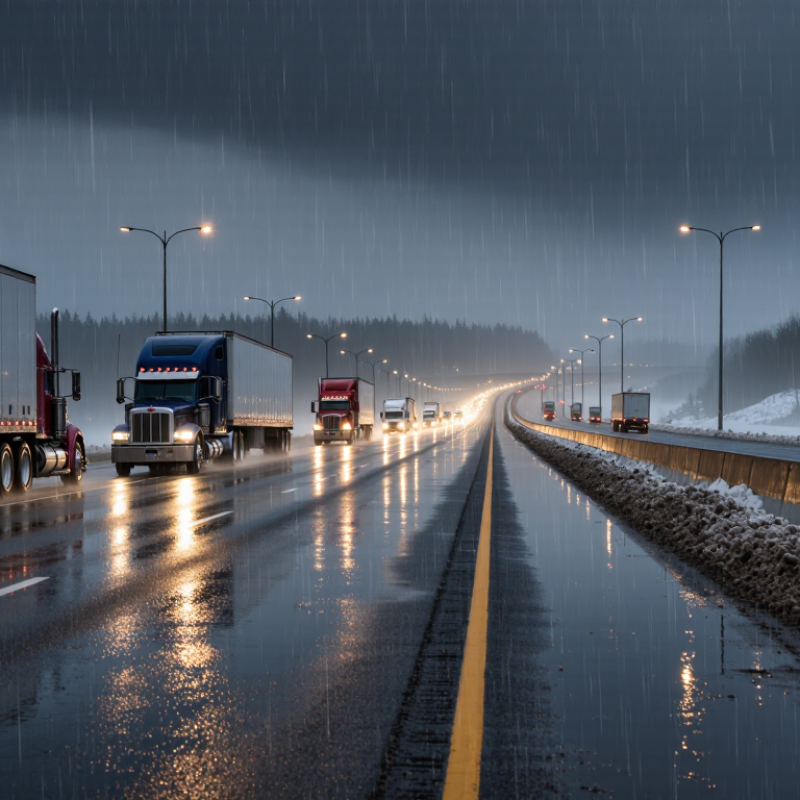
Weather conditions can change semi-trailer safety within minutes. FHWA reports that weather-related crashes account for about 21% of all crashes in the United States. This benchmark deserves attention from every freight operator. A loaded trailer needs more distance, especially on wet pavement, ice, or compacted snow. Sudden crosswinds can also push an empty trailer across its lane.
Rain creates a thin film between tires and asphalt. Visibility may drop before drivers recognize the danger. Strong winds are especially difficult near bridges, open fields, and highway exits. Drivers should reduce speed gradually, increase following distance, and avoid sharp steering. Tire pressure, tread depth, brakes, lights, and coupling equipment need careful inspection before departure. Small defects become serious during a storm.
Planning matters, but forecasts are not perfect. A route that looks safe at 7 a.m. may develop black ice by noon. Dispatch teams should monitor road alerts and allow practical delays instead of rewarding risky arrival times. Drivers also need permission to pause when conditions exceed their judgment. That sounds obvious. It is not always practiced.
The 21% benchmark should not be treated as a prediction for every semi-trailer trip. It is a warning about exposure and preventable decisions. Weather data, vehicle condition, cargo weight, and driver experience must be considered together. Even experienced drivers can misread shallow water or a sudden gust. Better safety often begins with admitting that uncertainty exists.
| Weather or Road Condition | Documented U.S. Crash Indicator | Primary Semi-Trailer Safety Effect | Risk Level for Heavy Combination Vehicles | Recommended Safety Controls |
|---|---|---|---|---|
| All weather-related conditions | Approximately 21% of all reported crashes | Reduced visibility, lower tire-road friction, longer stopping distances, and a greater chance of loss of control. | High | Reduce speed, increase following distance, use headlights, monitor road alerts, and postpone travel when conditions become unsafe. |
| Wet pavement | Approximately 73% of weather-related crashes involve wet pavement | Lower friction can increase braking distance and raise the risk of hydroplaning, trailer swing, and jackknife events. | High | Reduce speed smoothly, avoid abrupt steering or braking, inspect tire tread and inflation, and maintain extra stopping distance. |
| Rainfall | Approximately 46% of weather-related crashes occur during rainfall | Rain can impair forward vision, obscure lane markings, and create uneven traction across lanes and shoulders. | High | Use low-beam headlights, keep windshield and mirrors clear, avoid cruise control on slippery roads, and limit lane changes. |
| Snow or sleet | Approximately 18% of weather-related crashes involve snow or sleet | Compacted snow and ice sharply reduce traction, increase stopping distances, and can cause trailer tracking problems. | Very high | Travel only with suitable tires and properly functioning equipment, slow substantially, avoid sudden inputs, and use designated safe parking areas when necessary. |
| Fog | Approximately 3% of weather-related crashes involve fog | Short sight distance reduces the time available to detect stopped traffic, work zones, curves, or lane changes. | High | Use low-beam headlights, increase the gap to vehicles ahead, avoid high beams, and stop in a safe location if visibility becomes inadequate. |
| Strong crosswinds | No single national crash percentage is assigned in the FHWA benchmark categories | High-profile trailers are more sensitive to lateral wind forces, especially when empty, lightly loaded, or traveling across exposed bridges. | Moderate to high | Reduce speed, maintain firm steering control, avoid unnecessary lane changes, secure cargo, and follow applicable high-wind advisories. |
| Standing water or flooding | No single national crash percentage is assigned in the FHWA benchmark categories | Water can conceal road damage, cause hydroplaning, reduce braking effectiveness, and create a risk of vehicle loss of control. | High | Never enter unknown-depth water, avoid flooded roadways, slow before water accumulation, and reroute when warnings indicate road closure or unsafe depth. |
| Freezing rain or black ice | Included within winter-weather crash conditions; a separate national percentage is not specified in the benchmark | Thin ice layers may be difficult to see and can cause immediate loss of traction, especially during braking or steering. | Very high | Reduce speed before icy sections, avoid abrupt maneuvers, check route and pavement-temperature advisories, and suspend travel when safe control cannot be maintained. |
| Rapid weather transitions | Crash exposure varies by location, timing, traffic volume, and road treatment | A sudden change from dry to wet, clear to foggy, or above-freezing to icy conditions can catch drivers without adequate speed adjustment. | Variable | Reassess conditions continuously, adjust speed before entering the affected area, communicate delays, and plan additional time for weather-related interruptions. |
| Data note: The 21% benchmark and the weather-condition percentages are FHWA national indicators for weather-related roadway crashes, not a semi-trailer-only crash rate. The percentages for wet pavement, rainfall, snow or sleet, and fog may overlap because a single crash can involve more than one condition. Operational controls are presented as practical heavy-vehicle safety measures and should be applied together with current road, traffic, and weather advisories. | ||||
Weather-related crashes represent about 21% of United States crashes. This is a warning, not a trip prediction. Rain, ice, snow, and wind can change conditions within minutes.
Rain creates a thin film between tires and pavement. Stopping becomes longer and less even. Spray may hide lane markings, puddles, and brake lights.
Allow one second for every 10 feet of vehicle length. A 70-foot combination needs at least seven seconds. Above 40 mph, add one more second.
No. It is only a baseline. Heavy cargo, worn tires, steep grades, and crosswinds require additional space. I may follow the formula and still leave too little room.
Choose a fixed object, such as a sign or lamp post. Count after the vehicle ahead passes it. Your trailer should reach that object after the required seconds.
Reduce speed gradually and avoid sharp steering. Crosswinds become stronger near bridges, open fields, and highway exits. An empty trailer may move across its lane.
Inspect tire pressure, tread depth, brakes, lights, and coupling equipment. Small defects become serious during storms. Check again when conditions change.
Monitor road alerts and allow realistic delays. Drivers need permission to pause when conditions exceed their judgment. Arrival times should never encourage unsafe decisions.
Use low beams in fog and reduce speed. Snow and ice require much more space. Forecasts can miss black ice that forms later. Conditions are easy to misread.
How weather conditions affect semi trailer transportation safety is a critical concern because rain, snow, ice, strong wind, and poor visibility can quickly increase crash risks. Weather-related incidents are associated with a significant portion of roadway crashes, making careful planning essential. Wet or icy surfaces reduce tire friction, lengthen stopping distances, and make braking, steering, and cornering more difficult. Before departure, drivers should inspect tires, ensuring tread depth meets the applicable 4/32-inch standard for major tires and 2/32-inch minimum for other tires, while also checking brakes, lights, wipers, and mirrors.
Safe operation also requires greater following distance. Applying the one-second-per-ten-feet guideline can provide additional reaction time for longer semi trailers, especially when roads are slippery. During strong winds or limited visibility, drivers should reduce speed, monitor changing conditions, and confirm that cargo is properly secured under 49 CFR 393.102. Delaying travel when conditions become unsafe may be the most responsible safety decision.
